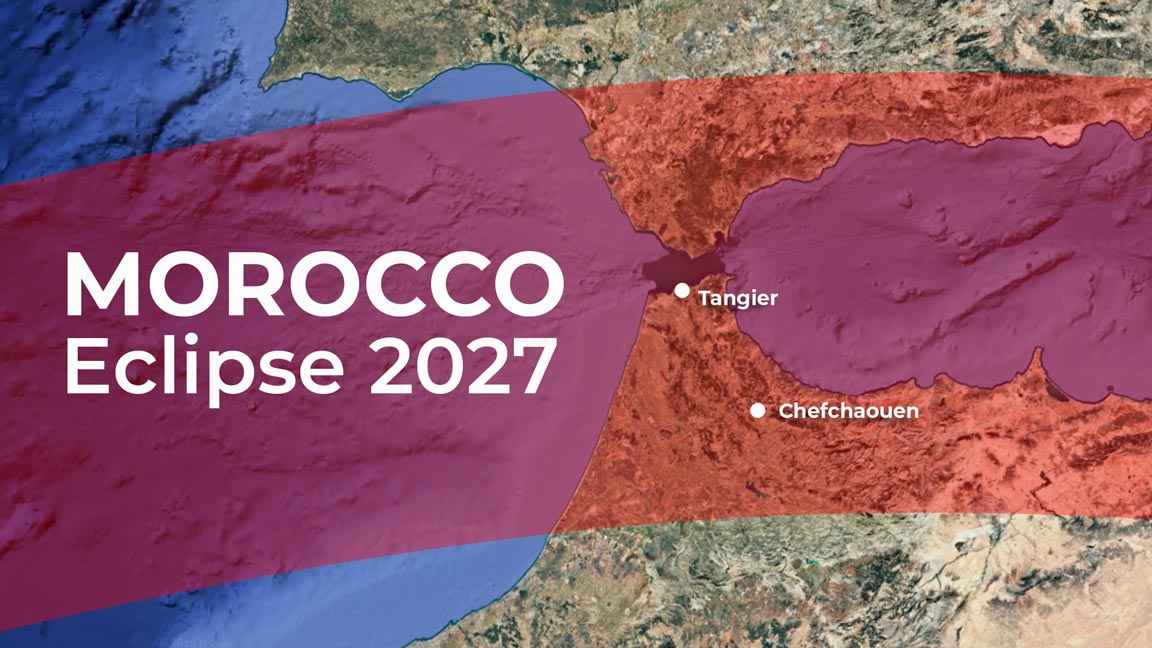
On Monday, August 2, 2027, the Moon’s shadow will cross the Strait of Gibraltar and sweep over northern Morocco, turning a summer morning into night. Astronomers nickname it the Eclipse of the Century, and Morocco is one of the best places on Earth to watch it: nearly five minutes of totality, reliable summer skies inland, and a landscape worth the trip on its own.
This guide covers exactly where totality happens in Morocco, what time it starts, what to expect from the weather, and how to plan a trip around it.
The eclipse at a glance
| Date | Monday, August 2, 2027 |
| Type | Total solar eclipse |
| Where in Morocco | Northern Morocco, including Tangier, Tetouan, Chefchaouen and Nador |
| Tangier, partial phase begins | about 8:40 am local time |
| Tangier, totality | about 9:44 am to 9:49 am (4 minutes 51 seconds) |
| Tangier, partial phase ends | about 11:00 am local time |
| Longest totality anywhere | 6 minutes 23 seconds, in Egypt |
Why this eclipse is special
- It is the second longest total solar eclipse of the 21st century.
- It is the longest total eclipse over easily accessible land this century. A longer one will not happen until June 3, 2114.
- Morocco gets far more darkness than neighboring Spain. Cadiz, on the Spanish side of the Strait, gets about 2 minutes 56 seconds. Tangier gets 4 minutes 51 seconds.
- The path crosses nine countries, and an estimated 89 million people live inside it. Expect crowds and early sell-outs.
Where you can see totality in Morocco
The centerline of the shadow passes just south of Tangier, then leaves Morocco for the sea. Only the north of the country is inside the path, so where you stand matters.
- Tangier: about 4 minutes 51 seconds, one of the longest totalities available in the country.
- Tetouan: about the same as Tangier, on the other side of the centerline.
- Chefchaouen: about 4 minutes 14 seconds, even though it sits closer to the southern edge of the path.
- Nador: about 4 minutes 16 seconds on the Mediterranean coast.
- Oujda: only around one minute, because it sits right on the edge of the path. Parts of the city fall outside it.
Exact timing shifts from one neighborhood to the next, so check your specific viewing spot on an interactive eclipse map before you book.
Where you will only see a partial eclipse
Casablanca, Rabat and Marrakech are outside the path. Casablanca reaches about 97 percent coverage, which sounds close, but the sky stays bright and you never see the Sun’s corona. The darkness, the drop in light and the corona only happen inside the path of totality. If the full eclipse is the goal, base yourself in the north.
What the morning looks like in Tangier
- About 8:40 am: the Moon starts to take a bite out of the Sun. You need eclipse glasses from this point.
- About 9:44 am: totality begins. Daylight drops fast, the horizon glows, and the Sun’s corona appears. If the sky is clear, Venus should be visible.
- About 9:47 am: the middle of the eclipse.
- About 9:49 am: totality ends and the glasses go back on.
- About 11:00 am: the partial phase finishes.
All times are local Moroccan time.
Weather: what to expect
The outlook for northern Morocco is generally good, but nobody can promise clear skies. The main risk is cloud along the coastline, while inland areas have a better chance of clear skies on eclipse morning. Long-term cloud averages help you compare regions but say nothing about a specific morning. Reliable forecasts only become available about 14 days before the eclipse, so build flexibility into your plan.
How to watch safely
Never look at the Sun without proper eye protection during the partial phases. Use certified eclipse glasses or viewers, and check them for damage before the day. The only moment glasses can come off is during the short window of totality, and they must go back on as soon as it ends.
How to plan your Morocco eclipse trip
- Book early. Reports of hotel sell-outs in southern Spain and Morocco appeared as far back as December 2025. Accommodation in the north will be the first thing to go.
- Be in the north the day before. Arrive in Morocco by July 31 and be in Tangier on the night of August 1. Eclipse morning is a bad time to be driving.
- Stay inside the path. Choose a base in Tangier, Tetouan or Chefchaouen, not in a city that only gets a partial eclipse.
- Have a second option. If the coast looks cloudy in the forecast, an inland viewing spot such as Chefchaouen gives you somewhere else to go.
- Plan for August heat. It is peak summer. Carry water, wear a hat, and keep your schedule light around the eclipse itself.
Building a full Morocco trip around the eclipse
The eclipse takes one morning. The rest of the trip is where Morocco does the work. One way to shape it: land in Casablanca or Marrakech, watch the eclipse in Tangier, then continue through Chefchaouen, Fes and the Sahara to Marrakech. Because August is the hottest month in the south, we plan desert stays and driving days carefully around the summer heat.
Every Simply Morocco trip is private, with your own driver and guide, so the route can be built around your dates rather than the other way around.
Frequently asked questions
Is the 2027 eclipse visible from all of Morocco? No. Totality is limited to the north. The rest of the country sees a partial eclipse.
Can I see totality from Marrakech or Casablanca? No. Both are outside the path and see a partial eclipse only.
What time is the eclipse in Tangier? Totality starts at about 9:44 am local time and lasts about 4 minutes 51 seconds.
How long is totality in Morocco? Up to about 4 minutes 51 seconds, depending on your exact location.
Do I need special glasses? Yes, for every phase except the brief moment of totality.
Will the weather be clear? Nobody can promise it. Inland northern Morocco has better odds than the coast, and forecasts become useful about two weeks out.
Recommended 10-day itinerary: watch the eclipse in Tangier
This 10-day private tour puts you in Tangier for the longest totality in Morocco, about 4 minutes 51 seconds starting at about 9:44 am. You land on July 31, reach Tangier on August 1, and never have to travel on eclipse morning.
- Day 1 (July 31): Arrival in Casablanca or Marrakech
- Day 2 (August 1): Tangier
- Day 3 (August 2): Tangier, eclipse in the morning, then Chefchaouen
- Day 4: Chefchaouen to Fes, with stops in Meknes and Volubilis
- Day 5: Fes guided tour
- Day 6: Fes to Merzouga, Sahara
- Day 7: Ouarzazate or Dades
- Day 8: Marrakech
- Day 9: Marrakech guided tour
- Day 10: Departure from Marrakech or Casablanca
A few things to know about this route:
- Tangier is on the coast, where cloud is the main weather risk on eclipse morning. Chefchaouen, a short way inland, is where you sleep the same night.
- Day 4 and Day 6 are long driving days, and Day 3 is a half day of driving after the eclipse.
- Landing in Marrakech makes August 1 a very long transfer to Tangier, so Casablanca is the easier arrival city. If you land in Marrakech, arriving on July 30 gives you a buffer.
- You depart from the city you landed in: Marrakech, or Casablanca after a transfer from Marrakech.
What the tour includes
- A private driver and guide, with private air-conditioned transportation for your party only.
- Airport pickup and drop-off, hand-picked accommodations and daily breakfast.
- Dinner in Ouarzazate or Dades, and at the Sahara desert camp.
- One night in the Sahara at Merzouga.
You arrange your own flights, and we build the route around your confirmed arrival and departure times. Prefer a longer trip? Ask us about the 14-day version.
Plan your eclipse trip with Simply Morocco
If you want to be in northern Morocco on August 2, 2027, tell us your travel dates, the number of travelers, and your preferred accommodation level (Standard, Affordable Lux or Deluxe). We will build a private trip around the eclipse. Send us an inquiry below.