
Ask anyone who has done a classic Morocco tour what they would change, and you often hear the same answer. Not a single city. Just the hours on the road.
It is a fair point, and it surprises a lot of first-time visitors. On the map, Morocco looks compact. Chefchaouen, Fes, the Sahara and Marrakech seem a few fingers apart. On the ground, they are separated by hundreds of kilometers and, more importantly, by mountains.
This article explains where the long drives come from, how long each leg really takes, what you see along the way, and how a few well-placed extra nights change the whole rhythm of the trip.
Morocco is bigger than it looks
Morocco covers 712,550 square kilometers, slightly larger than Texas. The places most travelers want to see sit at opposite ends of it. Chefchaouen is in the Rif Mountains in the far north. The dunes of Merzouga are in the southeast, near the Algerian border. Marrakech is in the southwest, at the foot of the High Atlas.
A full loop that connects them all, starting and ending at the airport, covers close to 2,000 kilometers.
The Atlas Mountains: the real reason the drives are long
Distance alone is not the problem. The Atlas is.
Three mountain ranges run across the middle of the country: the Middle Atlas, the High Atlas and the Anti-Atlas. They stand between the imperial cities of the north and the desert of the south. There is no way to reach the Sahara from Fes, or Marrakech from the Sahara, without crossing them.
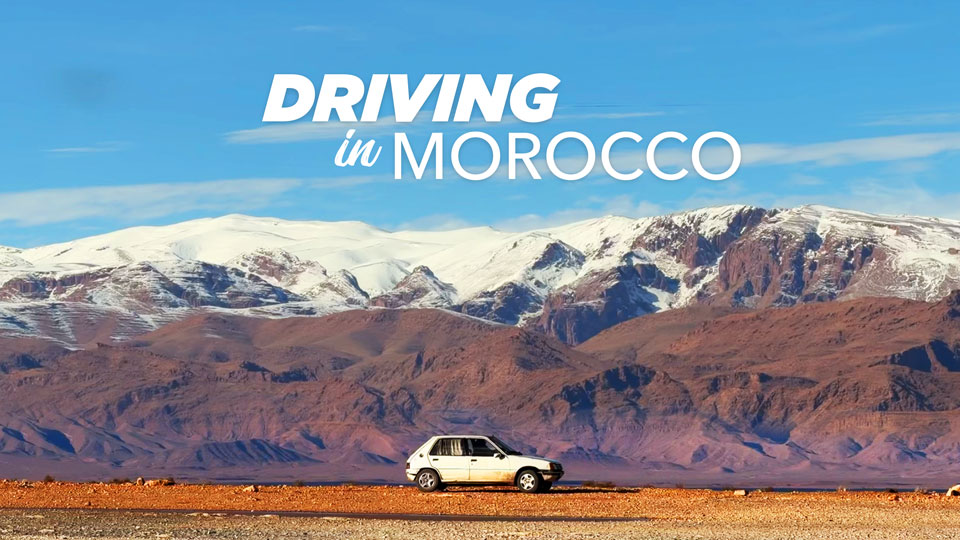
Mountain roads change everything. They climb through switchbacks, pass through villages, slow down behind trucks, and cross high passes like Tizi n’Tichka, which rises above 2,200 meters. On these roads, a realistic average is 50 to 70 km per hour, not highway speed. A 200 km stretch that looks like two hours on the map can easily take three and a half.
The good news: these are some of the most beautiful roads in North Africa. The drive is part of the trip. It just should not be the whole day, every day.
How long it really takes between cities
Approximate driving times, without photo, lunch or rest stops.
| Leg | Distance | Driving time | What you see on the way |
|---|---|---|---|
| Casablanca to Rabat | 90 km | 1 h 15 | Atlantic coast, the capital’s Kasbah of the Udayas |
| Rabat to Chefchaouen | 250 km | 3.5 to 4 h | Farmland of the Gharb plain, then the green hills of the Rif |
| Chefchaouen to Fes via Volubilis and Meknes | 280 km | 4.5 h | Olive groves, Roman ruins of Volubilis, the imperial gates of Meknes |
| Fes to Aguelmame Sidi Ali | 110 km | 2 h | Ifrane’s alpine houses, the Azrou cedar forest and its Barbary macaques |
| Aguelmame Sidi Ali to Merzouga | 360 km | 5.5 to 6 h | Middle Atlas plateaus, Midelt, the Ziz Gorges and palm groves, first dunes |
| Merzouga to Dades via Todra Gorge | 280 km | 4.5 to 5 h | Desert plains, Tinghir oasis, the walls of the Todra Gorge |
| Dades to Ait Ben Haddou | 145 km | 2.5 to 3 h | The Road of a Thousand Kasbahs, Rose Valley, Skoura palm grove |
| Ait Ben Haddou to Marrakech | 190 km | 3.5 to 4 h | The Tizi n’Tichka pass, Berber villages, High Atlas views |
| Marrakech to Casablanca | 240 km | 2.5 to 3 h | Highway across the Haouz and Chaouia plains |
Where the long drives are, and how we cut them
Most of the fatigue on a Morocco tour comes from three stretches. Here is what they look like on a fast itinerary, and what we do instead.
1. Fes to the Sahara
- Before: Fes to Merzouga in one day. About 470 km over the Middle Atlas, 7.5 to 8 hours of driving, plus stops. You reach the dunes tired, often just in time for the camel ride.
- After: we stop for the night at Aguelmame Sidi Ali, a quiet lake in the Middle Atlas, only 2 hours from Fes. You get a slow afternoon by the water, and the next day’s drive to the desert drops to 5.5 to 6 hours. It is still the longest day of the trip. The difference is that you start it rested.
2. The Sahara to Marrakech
- Before: Merzouga to Marrakech in one push. About 560 km, 9 to 10 hours on the road, crossing both the desert plains and the High Atlas.
- After: we split it into three short legs: Merzouga to the Dades Valley (4.5 to 5 h), Dades to Ait Ben Haddou (2.5 to 3 h), and Ait Ben Haddou to Marrakech (3.5 to 4 h). Every leg has something worth stopping for, and no day goes past 5 hours of driving.
3. Arriving and leaving the same day
- Before: arrive in Chefchaouen in the evening, leave the next morning for Fes. Arrive in the Sahara at sunset, leave at sunrise. You see the place, but you never settle into it.
- After: two nights in Chefchaouen and two nights in the Sahara. The second day has no driving at all.
Why we add a night here and there
Each extra night on Slow Morocco has a specific job.
- Chefchaouen, second night. Day visitors leave by late afternoon. With a full day, you see the blue lanes empty in the morning and walk up to the Spanish Mosque for sunset.
- Aguelmame Sidi Ali. Breaks the longest drive of the trip in two and gives you a quiet evening in the mountains before the desert.
- Sahara, second night. Sunrise over the dunes, time to visit the Gnawa musicians of Khamlia, or simply do nothing in one of the most peaceful places in the country.
- Dades and Ait Ben Haddou. Turn one exhausting 10-hour day into two easy ones through gorges, oases and kasbahs.
- Marrakech, third night. A free day after the guided tour, to go back to the places you liked or to rest before the flight home.
The Slow Morocco itinerary
14 days, 13 nights, Casablanca in and out. Five days have no driving at all.
- Day 1: Arrival in Casablanca
- Day 2: Casablanca to Chefchaouen via Rabat
- Day 3: Chefchaouen, free day
- Day 4: Chefchaouen to Fes via Volubilis and Meknes
- Day 5: Fes guided tour
- Day 6: Fes to Aguelmame Sidi Ali via Ifrane and Azrou
- Day 7: Aguelmame Sidi Ali to the Sahara (Merzouga)
- Day 8: Sahara, free day
- Day 9: Merzouga to the Dades Valley via Todra Gorge
- Day 10: Dades to Ait Ben Haddou via the Rose Valley
- Day 11: Ait Ben Haddou to Marrakech
- Day 12: Marrakech guided tour
- Day 13: Marrakech, free day
- Day 14: Marrakech to Casablanca airport
Making the road days easier
A few things make a real difference on travel days.
- Plan for the day, not the distance. Expect a travel day to take the driving time plus 1 to 2 hours for photos, lunch and breaks.
- Good stops matter. A driver who knows the clean cafes and rest stops along each route makes a long day feel much shorter.
- Know the plan the night before. Meeting time and place are confirmed each evening, so mornings are calm.
- Lunch customs. Drivers and guides often seat their guests and step away during meals to give them privacy. It is a courtesy, not a rule. If you would like company, invite them to join you.
Is Slow Morocco right for you?
If you have 9 or 10 days, a faster loop still works, as long as you know the road days are part of it. If you have two weeks, the extra nights give you something a shorter trip cannot: time to arrive before you leave.
If you would like a Slow Morocco itinerary built around your dates, fill the form below.