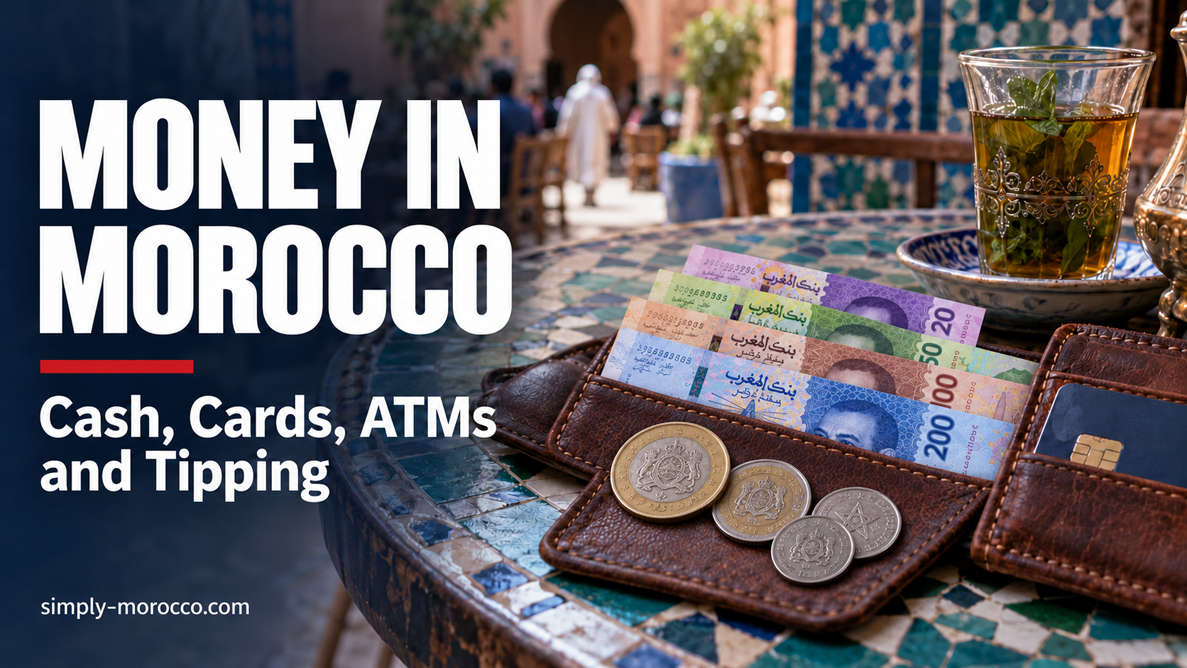
Morocco’s currency is the dirham (MAD), and it is a closed currency, so you get most of your dirhams after you land, from ATMs or exchange offices. Morocco is still largely a cash country: cards work in larger hotels, restaurants and shops, but you need cash for the souks, taxis, cafes and tips. Bring a debit card for ATMs, a credit card as a backup and some euros or US dollars in clean, recent notes.

This guide covers how to pay once you are in Morocco. For what the trip itself costs, see our guide to Morocco trip cost.
The Moroccan Dirham
The dirham is divided into 100 centimes. You will mostly use notes of 20, 50, 100 and 200 dirhams, and coins for small amounts.
Because the dirham is a closed currency, you can only bring a small amount in or out of the country. The current limit is 2,000 dirhams in either direction, so check the rule again before you travel. In practice, most travelers arrive with no dirhams at all and take cash out at the airport.
You can bring any amount of foreign currency into Morocco, but large sums must be declared on arrival.
Exchanging Money
- Where to exchange. Banks and exchange offices (bureaux de change) both change money, and exchange offices are usually faster. There are counters at the main airports, so you can change a small amount on arrival.
- Which currency to bring. Euros are the easiest to exchange, and US dollars are widely accepted too.
- Bring clean, recent notes. Banks and exchange offices often refuse old US notes, including those printed before 2000, and torn or marked notes.
- Keep your receipts. To change leftover dirhams back at the airport, you may be asked for an exchange receipt. Duty-free shops past passport control do not accept dirhams, so change your cash before you go through.
ATMs
ATMs are easy to find in cities and towns, and they are usually the simplest way to get dirhams. Cards on the Visa (PLUS) and Mastercard (Cirrus) networks work.
- Check your PIN. Some Moroccan ATMs only accept a four-digit PIN. If yours is longer, ask your bank to change it before you travel.
- Tell your bank you are traveling, so your card is not blocked.
- Check the fees. Your bank may charge for foreign withdrawals, and some Moroccan ATMs add their own fee.
- Get cash before remote areas. Take out what you need in the cities before heading to the Sahara, the gorges or the mountains, where ATMs are few and far between.
Credit Cards
Visa and Mastercard are accepted in many hotels, larger restaurants, carpet and crafts shops and supermarkets. American Express is rarely accepted. Smaller riads, cafes, market stalls and taxis usually take cash only, so always carry some dirhams.
How Much Cash to Carry
Carry enough for each day’s small costs, such as lunch, drinks, taxis, entrance fees and tips, and keep the rest in your hotel safe. Ask for small notes when you exchange or withdraw money: 20 and 50 dirham notes and coins are much easier to use than 200 dirham notes, because small shops and taxis often cannot give change. Supermarkets such as Marjane and Carrefour are good places to break a large note.
On our private tours, your hotels, transport, guided visits and the camel trek are already paid, so you only need cash for meals that are not included, shopping, extras and tips.
Tipping in Morocco
Tipping is not mandatory, but it is part of daily life in Morocco and is always appreciated. These are common guidelines, not fixed rules:
| Who | Common tip |
|---|---|
| Restaurants | Around 10 percent, or round up the bill |
| Cafes | A few dirhams for drinks |
| Petit taxis | Round up the fare |
| Porters and luggage help | 10 to 20 dirhams |
| Public toilet attendants | 1 to 2 dirhams |
| Local guides | 100 to 150 dirhams for a full day |
Tips are not included in the price of a private tour. Most travelers tip their driver and guides at the end of the trip, in an envelope or in person. Ask us when you book and we will tell you what is usual.
Bargaining in the Souks
In the souks, prices are usually not fixed, and bargaining is expected. Decide what something is worth to you before you ask the price, stay friendly, and walk away politely if the price is too high. In shops with marked prices, supermarkets and restaurants, prices are fixed. Read our guides to scams in Marrakech and scams in Fes before you shop.
Money Tips Before You Go
- Bring two cards from different banks, in case one is blocked
- Keep a little cash in a separate place from your wallet
- Download your bank’s app so you can lock a card if needed
- Keep small notes for tips and taxis
- Change leftover dirhams before you pass passport control
For the rest of your preparation, see first time in Morocco, Morocco visa requirements and how to use your phone in Morocco.
Money in Morocco FAQ
The Moroccan dirham (MAD). It is a closed currency, so you get it in Morocco rather than before you travel.
Some hotels and larger shops accept euros, and sometimes dollars, but prices are set in dirhams, so paying in dirhams is simpler. Change money or use an ATM when you arrive.
In many hotels, larger restaurants and shops, yes. Markets, taxis, cafes and small riads usually want cash.
Yes, in all cities and towns. They are rare in the desert and the mountains, so get cash before you go.
Around 10 percent in restaurants, small change in cafes and taxis, and 100 to 150 dirhams a day for a local guide. Tipping is appreciated but not mandatory.
Plan Your Trip
Now that you know how to pay, see what a private tour costs, compare a private driver vs the train and choose a route in our Morocco itinerary planner.
Tell us your travel dates, the number of travelers, your hotel level (Standard, Affordable Lux or Deluxe) and the city you are flying in and out of. Fill in the form below and we will send you a day by day itinerary and a quote.
Learn more about our private tours across Morocco, and follow Simply Morocco on Instagram and Facebook.